From Overwhelm to Action: How to Actually Use Business Data | CloudKnots
Blog

From Overwhelm to Action: How to Actually Use Business Data

Most small business owners have more data than ever but less clarity about what it means. Here's how to bridge the gap between "I have data" and "I know what to do about it."

July 6, 2026 7 min read By PR@CloudKnots
From Overwhelm to Action: How to Actually Use Business Data

You're sitting at your desk at the end of the month. Your accounting software is open. Your payment processor dashboard is open. You've got email reports from three different tools. Somewhere in all of this is the answer to whether your business is actually doing better than last month — but finding it feels like squinting at static.

You're not alone. Most small and mid-sized business owners have more data than they've ever had, but less clarity about what it means. The gap between "I have data" and "I know what to do about it" is wider than ever.

The good news? You don't need a data scientist to bridge that gap. You need to know the difference between data and real insight, which metrics actually matter to your business, and how to turn what you learn into decisions that move the needle.

Data vs. Insight: What's Actually Different?

Let's start with the confusion that stops most people. You look at a report and see numbers. That's data. But data by itself doesn't tell you anything.

Your revenue went up 12% last quarter. That's data. But if you don't know why, it's just noise.

An insight is the why — it's the pattern that explains what's happening and what you should do differently.

Here's what this looks like in practice: A coffee shop owner noticed that her weekday mornings were consistently busier than weekday afternoons. That's data. But then she dug deeper and realized that her morning staff was turning over customers twice as fast as the afternoon team, and it had nothing to do with how good they were. Her morning crew was trained on a slightly different prep process that saved 90 seconds per order.

That's the insight. And once she had it, the decision was obvious: retrain the afternoon team on the same process. Within two weeks, she'd smoothed out the bottleneck and increased her total weekday output by 30% without hiring anyone new.

Data doesn't do that. Insight does.

Which Metrics Actually Matter?

Here's where small business owners usually go wrong: they try to measure everything.

Vanity metrics are seductive. Your email open rate sounds important until you realize it has nothing to do with whether customers stick around. Your social media followers sound like progress until you realize none of them are buying.

Instead, focus on metrics that directly connect to the health of your business:

Revenue and profitability — the most obvious, but often the least understood. Not just total revenue, but revenue per transaction, revenue by product line, or revenue per customer type. Profitability isn't just the difference; it's the rate at which you're making money on what you sell.

Customer retention and churn — this is the quiet metric that changes everything. A business that keeps customers longer is more profitable, even if it doesn't get many new ones. Most SMBs focus on getting new customers while bleeding existing ones out the back door.

Efficiency metrics specific to your work — for the coffee shop, it was order turnaround time. For a service business, it might be how many clients you close per proposal sent. For a product business, it might be how long between purchase and delivery. Find the one thing that, if it got better, would visibly improve your bottom line.

Time to insight — how fast you can actually turn data into a decision and act on it. The longer this takes, the less valuable your data becomes.

What not to measure: anything that doesn't directly connect to a decision you can actually make. If you can't act on it, it's clutter.
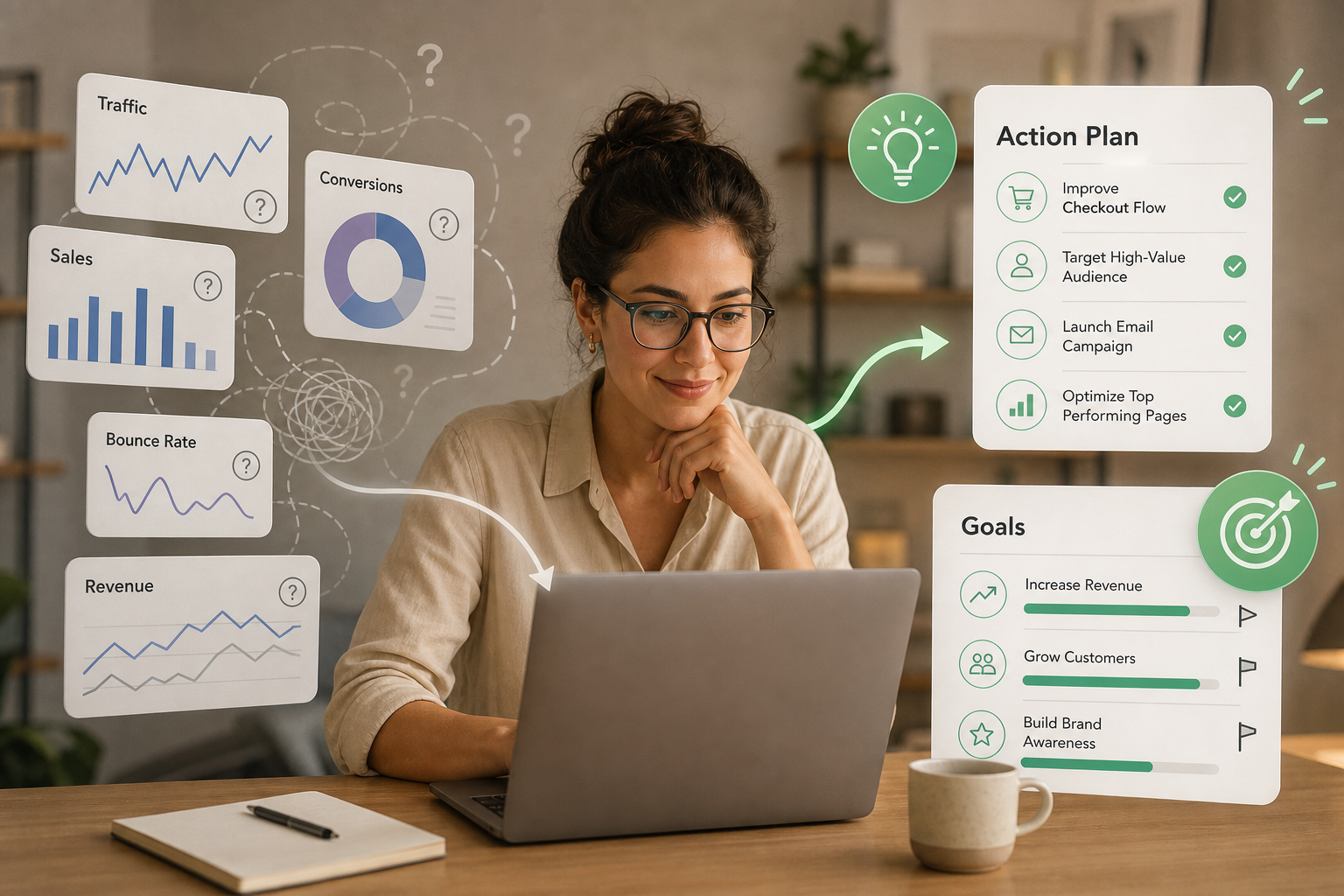
From Insight to Action

Finding a pattern is useful. Acting on it is everything.

This is where most data efforts die. The insight sits in a report. It's "interesting." Someone says they'll look into it next quarter. Nothing changes.

The coffee shop owner didn't just notice the prep process difference — she immediately tested whether retraining would work, saw the results, and rolled it out. That turned data into money.

Here's the framework:

1. Spot the pattern. Look at your key metrics and ask: what's different from last month, last quarter, or last year? What's surprising?

2. Form a hypothesis. What do you think is causing this pattern? The coffee shop owner hypothesized that the morning team's process was the difference. Be specific.

3. Test it. Don't spend six months debating. Run a small experiment. The coffee shop owner trained one afternoon shift on the new process. It worked. If it hadn't, she'd have learned something else valuable.

4. Act or iterate. If the hypothesis holds, roll it out. If it doesn't, you now know something that changes what you look at next.

This whole cycle shouldn't take weeks. It should take days.

The Real Barrier Isn't Data — It's Time

Most SMB owners have the data. What they don't have is the time to dig through it, spot patterns, form hypotheses, and test them. You're running the business. You don't have a team of analysts.

That's exactly the problem that operational intelligence tools exist to solve. Instead of spending your evening pulling numbers from five different places and trying to spot the pattern, a good tool does the heavy lifting: it pulls your data together, spots patterns for you, and surfaces the ones that matter. It turns a three-hour analysis session into a 10-minute conversation with something that actually understands your business.

The goal isn't more data. It's faster insight. It's the ability to ask a question on Monday and have an answer — with a hypothesis and a next step — by Wednesday.

Start Small

You don't need to rebuild your entire reporting infrastructure. You don't need to hire anyone.

Start with your most important metric. The one that, if it got better, would genuinely make your month. Track it. Look for patterns. Form a hypothesis. Test it.

Do that three times. You'll be shocked at what you learn.

Because here's the truth about business data: it's not complicated. You just need to know the difference between noise and signal, focus on what matters, and actually act on what you find.

Everything else is noise.

Want to move from overwhelm to clarity faster? Try out Theama for FREE to see how operational intelligence can turn your data into decisions in minutes, not months.

Share this article

Ready to Turn Your Data Into Decisions?

Stop drowning in reports. Start acting on insights that actually move the needle for your business.